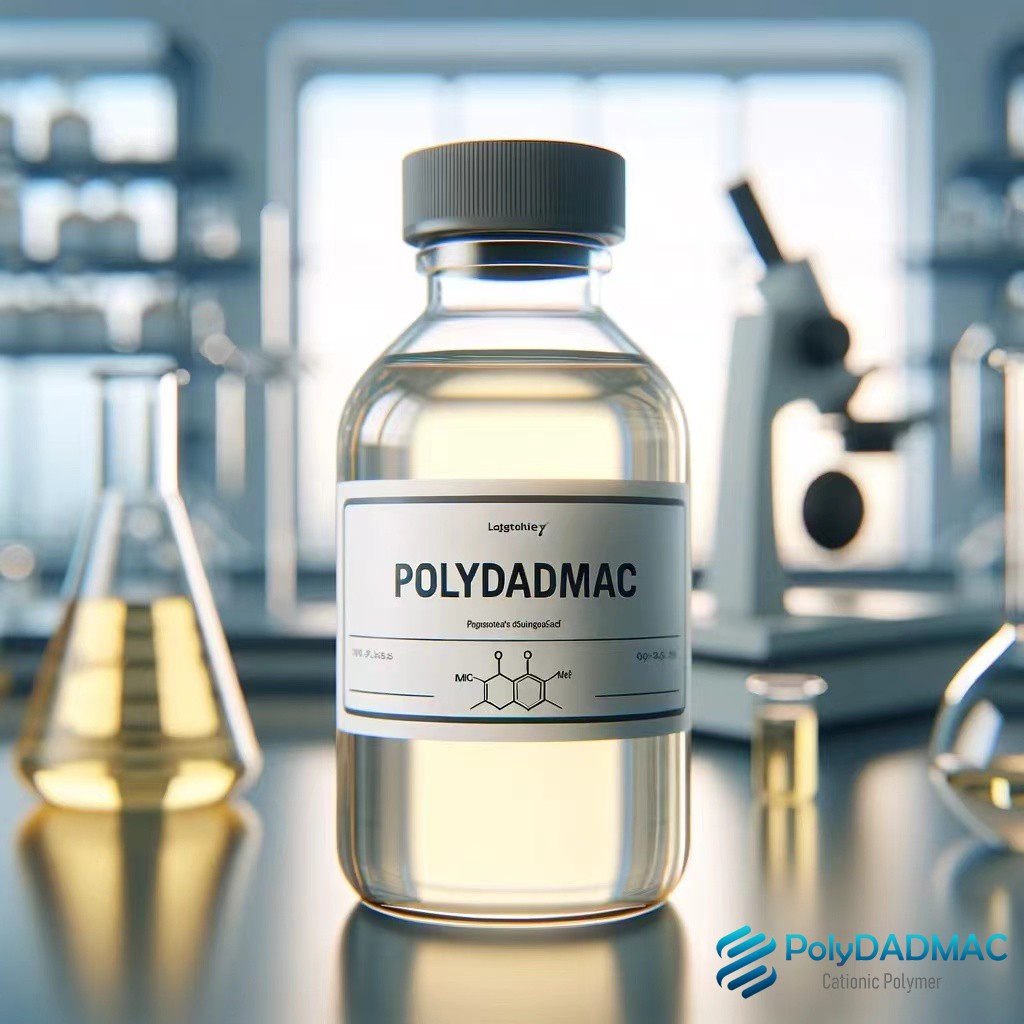
Polydiallyldimethylammonium chloride (commonly abbreviated as PolyDADMAC) is a synthetic, water-soluble cationic polyelectrolyte widely used in industrial and municipal applications due to its strong positive charge and ability to interact with negatively charged particles.
Chemical name: Poly(diallyldimethylammonium chloride)
CAS Number: 26062-79-3
Monomer unit: Diallyldimethylammonium chloride (DADMAC)
General formula: ([–CH_2–CH(CH_2–N^+(CH_3)_2–CH=CH_2)–Cl^––]_n)
Appearance: Typically supplied as a clear, viscous aqueous solution (e.g., 10–50% active concentration), though solid forms exist.
Charge density: Very high (fully quaternary ammonium groups → permanent positive charge, independent of pH)
Water & Wastewater Treatment:
Acts as a primary coagulant or flocculant aid.
Neutralizes negative charges on colloids (e.g., clay, organic matter, microbes), enabling particle aggregation and removal via sedimentation or filtration.
Effective at low doses; often used before anionic polymers in dual-polymer systems.
Paper Manufacturing:
Retention aid: Helps retain fine fibers and fillers on the paper sheet.
Drainage promoter: Improves dewatering on the wire section.
Dry strength additive: Enhances paper strength.
Cosmetics & Personal Care:
Used in conditioners, hair masks, and skin products for its antistatic and film-forming properties.
Binds to negatively charged hair/skin surfaces, improving softness and manageability.
Other Uses:
Sludge dewatering
Textile processing
Enhanced oil recovery (EOR)
Biocidal formulations (due to quaternary ammonium structure)
Highly effective at low dosages
Works over a wide pH range (charge is pH-independent)
Rapid action in coagulation/flocculation
Compatible with many other treatment chemicals
Can be expensive compared to inorganic coagulants (e.g., alum, ferric chloride)
Overdosing may restabilize colloids (charge reversal)
Requires careful handling—irritant to eyes/skin in concentrated form
In summary, PolyDADMAC is a versatile, high-performance cationic polymer essential in processes requiring charge neutralization and particle aggregation—especially where efficiency, clarity, and low sludge volume are priorities.