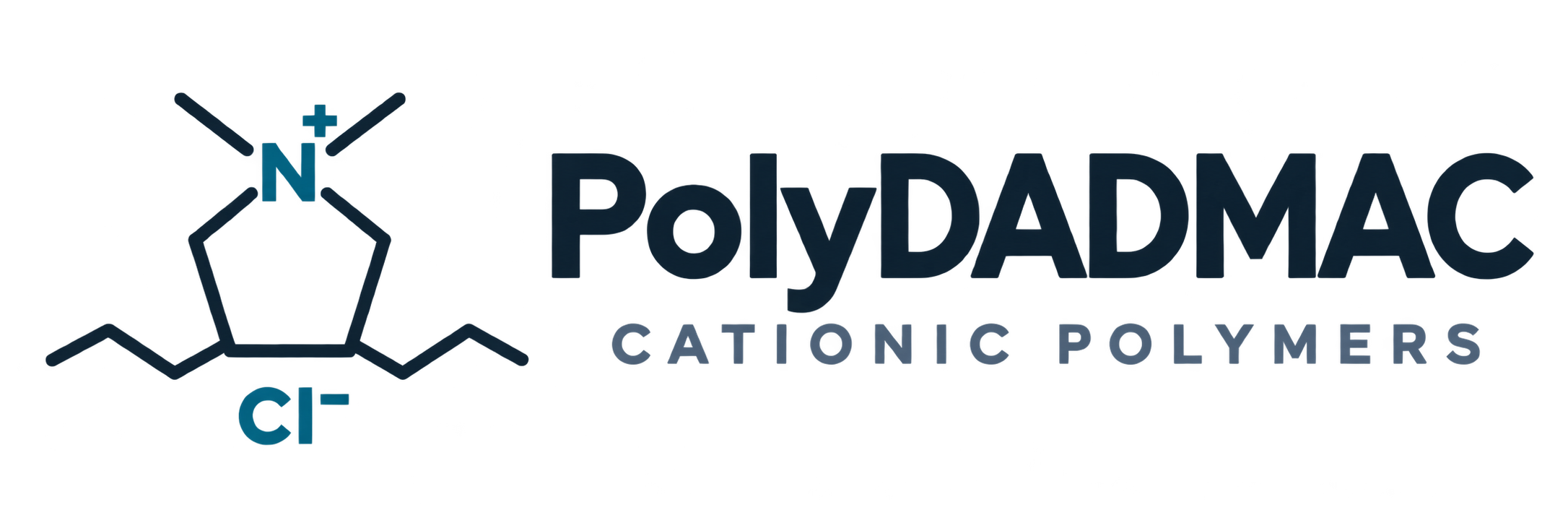
PolyDADMAC is primarily made from a specific chemical building block known as a monomer, which is then synthesized into a polymer. Here is the breakdown of what it is made from:
1. The Core Monomer
The fundamental raw material is diallyldimethylammonium chloride, commonly abbreviated as DADMAC or DMDAAC. This monomer is a water-soluble quaternary ammonium compound that provides the strong positive charge (cationic nature) to the final product.
2. The Synthesis Process
To create PolyDADMAC, the DADMAC monomer undergoes radical polymerization.
Catalysts: This reaction requires an initiator, typically an organic peroxide or azo compound, to trigger the linking of the monomer units.
Molecular Structure: During this process, the monomer strongly favors forming a five-membered ring structure within the main polymer chain, specifically an N-substituted pyrrolidine structure.
3. Commercial Formulations
Because the pure polymer is highly viscous, the commercial PolyDADMAC you purchase is typically formulated as a mixture containing:
Active Polymer: The synthesized PolyDADMAC.
Water: It is most commonly delivered as a liquid concentrate, with the active polymer (solids level) typically ranging from 10% to 50%.
Solid Form: It can also be manufactured as a white, hygroscopic powder or flake with a solid content of ≥88%.
In short, PolyDADMAC is essentially a long-chain, high-charge-density cationic polymer made by linking thousands of DADMAC monomer molecules together.